In today's digital landscape, mobile phones have emerged as prime targets for fraudsters, given their ubiquitous presence and the wealth of sensitive data they store. As per various online sources, the value of online financial frauds reached to ₹5574 crore in 2023. Fraudsters relentlessly evolve their tactics, targeting the banking and financial sector, drawn by the potential for substantial monetary gains and exploiting vulnerabilities across industries.
Prioritizing security in mobile banking apps is not just about protecting customers from fraud, but it is about safeguarding the bank's brand reputation in an interconnected digital ecosystem.
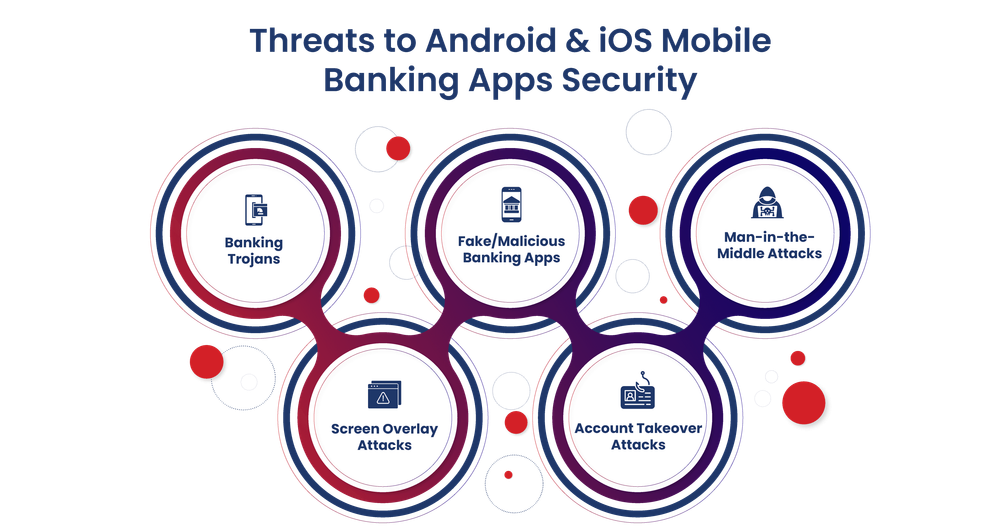
Threats to Android & iOS Mobile Banking Apps Security
As banking customers embrace mobile banking as their channel of choice, the security of that channel is paramount.
- Banking Trojans - Banking trojans are malicious software (malware) designed to steal sensitive financial information from banking apps, such as online banking credentials, credit card numbers, and personal identification details. Trojans Infiltrate Mobile Banking Apps with their stealthy and versatile nature, can exploit various entry points to gain access to mobile banking apps. Trojans can enter mobile banking apps through various means, such as Malicious Apps, App Downloads, Phishing Attacks, Unsecured Wi-Fi Networks, and more.
- Fake/Malicious Banking Apps- Malicious banking applications, often designed to mimic legitimate banking apps, can deceive users into divulging sensitive financial information, leading to fraud and identity theft. When installed, fake banking apps may request excessive permissions that surpass the requirements of a legitimate banking application. Malicious apps can compromise the security of the user's device, potentially leading to further exploitation or unauthorized access to banking accounts.
- Man-in-the-Middle Attacks – In a Man-in-the-middle attack, fraudsters exploit unsecured network connections and intercept and manipulate communication between the app and its server. Unsecure public Wi-Fi networks are common environments for MitM attacks.
- Screen Overlay Attacks – In the screen overlay attack part of the application screen is covered by a fake (malicious) screen to trick the user into interacting with. Users assume that they are interacting with a legitimate app or service, but they interact with the overlay screen controlled by the fraudster.
- Account Takeover Attacks - In an account takeover Attack fraudster gains unauthorized access to a user's mobile banking app by stealing their login credentials or exploiting mobile app security vulnerabilities.
Elevate the security posture of your Android & iOS Mobile Apps
With the significant rise in security threats in the Android & iOS mobile banking apps, Banks and other financial institutions should protect their endpoints from emerging frauds.
- Implement Runtime Application Self Protection (RASP) RASP technology operates within the application runtime environment to detect and prevent security threats and attacks. It protects mobile apps from cyber-attacks by identifying and blocking them at runtime. It analyzes the mobile application's behavior in real-time, looking for signs of suspicious or malicious activities. RASP can take immediate action to prevent it, such as blocking the attack, terminating the session, or alerting the security system. RASP secures Android & iOS mobile applications from reverse engineering, app tampering, jailbroken/rooted devices, and proxy networks offering application security and preventing any potential attack.
- In-app protection - Refers to the security features built into mobile apps to protect the app and the data from unauthorized access, theft, or tampering. Multilayered Protection makes the application more resistant to attacks such as malicious data exfiltration, intrusion, tampering, and reverse engineering.
- RBI (Reserve Bank of India) Compliance – RBI Digital Payment Security Control (DPSC) made a mandate for banks to implement Mobile App Runtime Application Self-Protection (RASP) aiming at enhancing the security of digital banking channels, and mobile banking apps. Ensuring security for the growing digital payment landscape Regulated Entities (RE) like commercial banks, payment banks, small finance banks, and credit card issuing NBFCs (Non-Banking Financial Companies) are required to follow mandates for mobile application payment ecosystem.
Mitigating Mobile App Security Threats with India’s #1 Mobile App Security platform: AppProtectt
Addressing the rapid rise in cyber incidents on mobile apps requires a comprehensive approach combined with technological solutions.
Strengthen Android App Security and iOS App Security effortlessly with Runtime Application Self-Protection (RASP) and Extended Threat Detection & Response (XDR). AppProtectt delivers 100+ mobile security features, real-time threat dashboards, flexible security configuration, and DevSecOps-driven protection while aligning with global compliance standards like RBI, DPSC, NPCI, and MITRE.
Key Capabilities:
- Compliant to RBI Security Guidelines
- In-app Protection
- Lightweight and Easy to Integrate SDK
- Powered by Artificial Intelligence and Behavioural Science
- Provides Single Dashboard to Monitor Enterprise Security
- Over-the-Air Updates - Anywhere, Anytime
- 360-degree Mobile App Security
- Available for Android and iOS
To know more and have a detailed demo, please get in touch with us on sales@protectt.ai
Protectt.ai is ‘A Leader in Mobile App Security in India.’ Built India’s first SaaS-based, Innovative Mobile App Security platform with Runtime Application Self Protectionacapabilities. Protectt.ai is delivering the next generation Mobile App, Device & Transaction Security Platform with 50+ Mobile App Security features driven by Deep Tech.