For decades, the One-Time Password (OTP) was hailed as the definitive standard for digital trust. However, the digital landscape must now move beyond the inherently vulnerable and exposed SMS token. With cyber-fraud now operating at an industrialized scale, the verification methodologies require a radical revolution.
In today's mobile-first economy, enterprises are constantly navigating the tension between frictionless user journeys and robust security protocols. While the OTP ritual once provided a functional equilibrium, it has loopholes. For a modern mobile app security posture to survive against increasingly sophisticated and lethal threats, these legacy rituals must evolve, and the loopholes must be resolved. Silent Mobile Verification is a robust alternative. Read ahead to find out more.
What is Silent Mobile Verification?
Silent Mobile Verification (SMV) is a process touted as the next generation of password-less authentication. This protocol is engineered to confirm a user’s mobile number possession with maximum assurance while providing a frictionless experience. In the background, SMV executes a secure connection between the device’s SIM card and the operator of the mobile network.
By shifting the security model, SMV replaces the "fragile shared secret" (the SMS OTP) with a high-assurance, network-verified signal. Because there is no manual code to intercept or input, Silent Mobile Verification naturally neutralizes common attack vectors, including social engineering and phishing schemes.
What is Silent Network Authentication (SNA)?
Silent Network Authentication is the underlying network protocol; the cryptographic "handshake" between the SIM and the carrier. Silent Mobile Verification is the functional application of that technology, providing the frictionless, brand-specific verification experience that replaces the "fragile shared secret" of SMS OTPs.
The Critical Need for Silent Mobile Verification
The OTP was originally conceived as a secure bastion, a temporary, possession-based token. Today, that ritual has devolved into a systemic liability for both the end user and the mobile-first enterprise.
For the User: The OTP introduces jarring friction, forcing users to interrupt their journey, exit the app, and wait for an external message. This fragmented process can be a primary driver of high abandonment rates during high-intent moments like account creation or payments.
For the Business: Beyond the friction, OTPs represent a massive security gap. They are increasingly vulnerable to interception through SIM swapping, device-level compromises, and sophisticated social engineering. Businesses find themselves financing a legacy measure that simultaneously frustrates legitimate customers and fails to deter modern attackers.
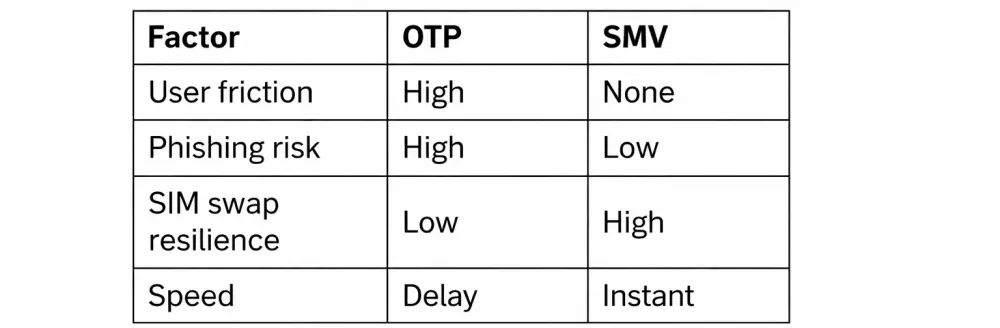
Silent Mobile Verification vs OTP Authentication
Here’s a side-by-side comparison highlighting the differences in user experience, security, and fraud resilience between OTP and SMV.
Key Benefits of Silent Mobile Verification for the End User
Silent Mobile Verification transforms the authentication experience by shifting the burden of proof from the user to the network. Here is how it enhances the user journey:
Instant, Invisible Authentication: SMV automates the verification process in the background, completely removing the need for manual codes or passwords. For instance, when a customer opens an e-commerce app and taps "Log In," they are authenticated immediately, bypassing the frustrating delay and context-switching of waiting for an OTP.
Phishing-Resistant Identity: By validating identity directly through carrier-grade signals, SMV eliminates the "exposed data point" (SMS code). Since there is no physical token for a user to inadvertently share, the process becomes inherently resistant to phishing attacks, protecting users even if they are targeted by social engineering tactics.
Strategic Benefits of Silent Mobile Verification for Businesses
For mobile-first enterprises, SMV isn't just a security upgrade; it's a conversion engine. By moving beyond legacy authentication, businesses can achieve:
Elevated Conversion Rates: By removing the primary point of friction—the manual OTP entry—at critical junctures like onboarding and checkout, businesses can drastically lower abandonment rates and drive higher transaction volumes.
Fortified Fraud Prevention: SMV utilizes direct network-level verification and device-binding signals to neutralize "industrialized" threats. This architecture effectively significantly reduces the effectiveness of SIM swap attacks, as there is no transient code to hijack.
Enterprise-Grade Scalability: Built on direct carrier integrations, SMV offers a robust and consistent authentication performance. The protocol is designed to handle high-velocity traffic and massive user bases seamlessly, ensuring that security never becomes a bottleneck for growth.
Silent Mobile Verification: Preventing Common Fraud Scenarios
SMV shifts the authentication battleground away from the vulnerable SMS inbox, providing robust defence against the most prevalent mobile-centric fraud schemes:
Account Takeover (ATO): Successful interception of the OTP is the final step allowing unauthorised access to a legitimate user's account, resulting in immediate financial loss or data theft.
Defence: SMV eliminates the exposed OTP factor, effectively cutting the primary attack vector for ATO at its root.
Identity Theft: By compromising the user's possession factor (the phone number), fraudsters gain control of the digital identity, facilitating wider Identity Theft across multiple platforms.
Defence: Real-time, network-verified possession check during authentication ensures the user's digital identity remains locked to the legitimate device.
Silent Mobile Verification: Industry-specific Use Cases
SMV is valuable for any enterprise where transactional integrity and seamless, high-volume user access are critical.
Financial Services & Fintech: SMV is critical for securing high-value transfers against SIM Swap Fraud and ATO.
E-commerce & Retail: Can be used to accelerate checkout conversion rates by eliminating OTP friction at the payment stage, translating directly into higher sales volumes.
Gaming & Entertainment: Essential for verifying user identity at registration and preventing fraud associated with account creation and payout systems where large virtual assets are involved.
Telecommunications & Utilities: Used to secure account management, password resets, and high-risk subscription changes against unauthorized access and Identity Theft.
AppSMV: Silent, No-OTP Network Handshake
Protectt.ai’s AppSMV delivers the essential "silent, no-OTP network handshake," providing the ultimate balance between mobile app security and an effortless user experience. Here is how AppSMV adds value.
Ready Deployment Platform: Delivered as a comprehensive, readymade platform, AppSMV drastically reduces time-to-market. Its developer-friendly SDK and management portal allow for rapid integration and immediate scalability.
High-assurance Authentication: AppSMV facilitates seamless API-level integration with telecom networks. By validating mobile number possession directly against real-time operator records, it ensures a high-assurance authentication process that legacy methods cannot match.
Deployment Versatility: Designed for high-stakes environments, AppSMV supports both on-cloud and on-premise infrastructure. This flexibility is critical for compliance-heavy sectors, such as banking and insurance, that demand rigorous control over their data ecosystems.
Total Compatibility: AppSMV is fully compatible across the entire SIM spectrum, including physical SIMs, eSIMs, and iSIMs.
For detailed information on how AppSMV works, please visit our AppSMV page.