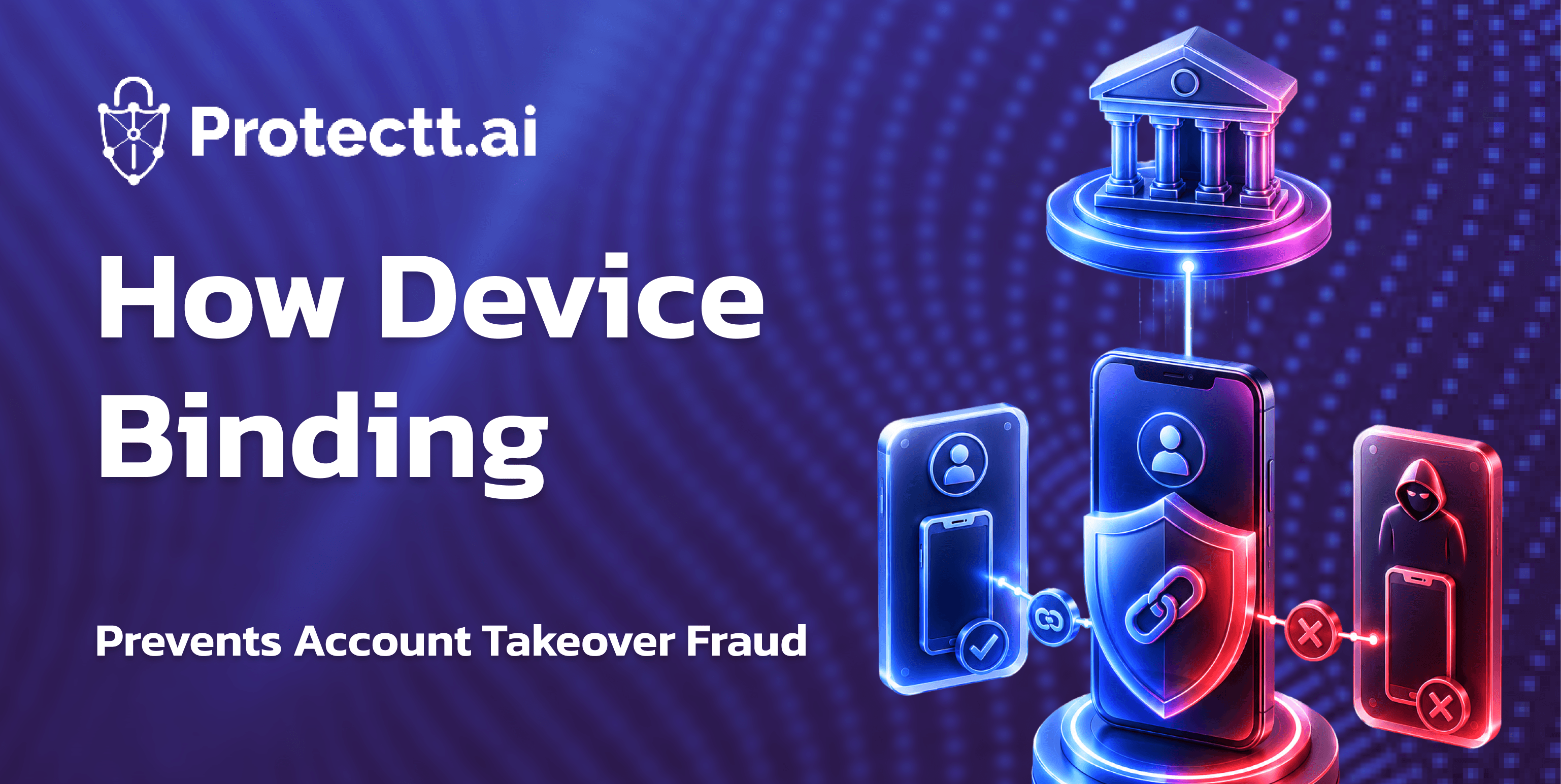
USA regulators have clearly stated that passwords and One-time passcodes can no longer be used alone for authentication. In July of Last Year, NIST listed SMS and PSTN One-time passcodes as “restricted authenticators” for the first time, creating a new category. The New York State Department of Financial Services went even further, issuing a warning to covered entities that the use of Text-based or Push-Based Multi-Factor Authentication (MFA) continues to remain vulnerable to SIM swapping.
The following covers what device binding is, how enrollment and verification work, why account takeover continues to rise, how it compares to device fingerprinting and MFA, where SIM binding fits into your solution set, and how to evaluate a device binding solution.
What Is Device Binding?
Through cryptographic binding with a user's mobile/PC, the end-user is tied directly to the physical device they registered on; therefore, the only way for the application to authenticate the user is by matching both the information entered in by the user when logging into the system with the information previously stored during the initial registration process (hardware); thereby providing protection against users being phished, guessing passwords, or having their password replayed.
So what is device binding? During enrollment, an application will create a key-pair. It will store the private key within hardware backed storage (i.e. the Android Keystore or the iOS Secure Enclave), and register the corresponding public key with the account. All subsequent sessions require the application to sign a challenge issued by the server. A password proves knowledge; a texted code proves control of a number a carrier can reassign. A bound-device signature proves control of hardware whose private key never leaves the secure element, which puts device binding for mobile apps in a different class.
How a Trusted Device Links to a User Account
The link forms through three parts: the account identifier, the hardware-backed key, and a device identity profile built from stable hardware and OS attributes. A device binding solution holds it server-side and re-verifies at every login and high-risk transaction, answering the Improper Credential Usage risk OWASP ranks M1 in its Mobile Top 10 2024.
Authentication Flow
1. The customer signs in with a credential or biometric.
2. The server issues a cryptographic challenge.
3. The app signs it with the hardware-protected private key.
4. The server validates the signature against the registered public key.
5. A risk engine scores the session on device telemetry and behavior.
6. Access is granted, challenged, or blocked.
Common Enterprise Use Cases
● Device binding for banking apps covering login, payee addition, and fund transfer
● Brokerage platforms guarding trade execution and withdrawals
● Insurance apps protecting claims and payout changes
● Wallet apps enforcing secure device registration for banking flows
● Government and healthcare portals requiring trusted device authentication
How Device Binding Works
How device binding works is a lifecycle running from first launch through continuous re-verification. Five stages run in sequence, and a mature enterprise device binding solution instruments all five.
1. Device Registration
The SDK will collect hardware and OS characteristics. Generate an asymmetric key pair within TEE. Submit the public key with a digitally-signed attestation. Android uses both Play Integrity (formerly known as Google Play Protect) and Keystore attestation. iOS uses DeviceCheck and App Attest.
2. Identity Verification
Registration does not prove anything regarding the identity of the person holding the device. The platform verifies that this individual is indeed human by referencing their Know Your Customer (KYC) records, asking them for a step up challenge, collecting in app biometric information, or verifying their mobile carrier number. If you skip registration then you are now "binding" the attackers' phone to the victim's account.
3. Secure Device Association
The server writes the link between account, public key and device profile. Policies determine how many devices may be associated with an account, what steps are required to change device binding, and for how long a device binding remains valid.
4. Risk Evaluation
Each session scores before access opens by evaluating variables like root/jailbreak status, emulator and cloned app detection, hooking frameworks, proxy usage, mock location, SIM state changes and cross- account velocity. Device risk assessment for mobile apps turns those into one decision: allow, challenge, or deny.
5. Continuous Device Validation
Binding is not a one-time gate. The SDK re-attempts to prove the integrity of the device throughout the session, watching for overlay and screen mirroring attacks, before sensitive actions act on the device.
Workflow diagram brief for design:
[App Launch]
|
[Device Attestation + Key Generation] -- fails --> [Block / Remediate]
|
[Identity Verification: KYC, biometric, carrier check]
|
[Secure Device Association stored server-side]
|
[Session Risk Scoring: root, emulator, SIM change, behavior]
|
[Allow] [Step-Up Auth] [Block + Alert Fraud Ops]
|
[Continuous Validation until session ends]
Why Account Takeover Fraud Is Increasing?
Attackers have industrialized every stage of the ATO pipeline, and mobile is the preferred entry point. The FBI's Internet Crime Complaint Center logged over a million complaints in 2025 for the first time, with reported losses of $20.877 billion. Here’s why ATO is increasing:
● Credential stuffing. The Identity Theft Resource Center found that last year’s data compromise record was 3,322. Verizon’s 2026 Data Breach Investigations Report found that credential stuffing was involved in 39% of data breaches.
● Phishing. Javelin’s study found that phishing losses tripled from year to year, primarily due to the use of AI to create phishing emails with no spelling errors. Today, cybersecurity companies focus less on teaching individuals to recognize phishing attempts and more on ensuring that credentials obtained through such means are of no use to the bad actors.
● SIM swap fraud. IC3 received 982 complaints regarding SIM swap fraud in 2024, and the average loss per person was $26,400. With SIM swap fraud, all SMS messages from the mobile number are redirected to the fraudulator.
● Malware. Banking trojans can intercept authentication codes and display a fake login screen for users. Insufficient Binary Protections (M7) was added to the Mobile Top 10 in 2024 after researchers noted that banking trojans can analyze the data from legitimate apps to create copies of those apps.
● Social engineering. The FBI reported that a public service announcement regarding bank fraud orchestrated by criminals who impersonate bank support agents received over 5,100 complaints and $262 million in losses. These criminals often use spoofed calls, websites, and SEO poisoning to direct unsuspecting users to their fraudulent pages.
● Session hijacking. Attackers can use infostealers to steal the session cookies and tokens associated with an authenticated user. Armed with this information, the hacker can gain access to the victim’s account without asking for their login information.
● Stolen credentials. Verizon recorded stolen credentials at 36% across breach action varieties.
Benefits of Device Binding
Below are the following benefits of mobile device binding:
Benefit | Business Impact |
Prevents account takeover | Protects customer accounts |
Stronger authentication | Reduces unauthorized access |
Improves fraud detection | Identifies suspicious devices |
Reduces false positives | Provides a better user experience |
Improves customer trust | Boosts user confidence |
Improves compliance support | Meets financial regulations |
Fraud teams underestimate the false-positive line. Engines without durable device identity compensate by challenging more sessions, and every challenge costs transactions. Once banking app device binding recognizes a clean handset, routine activity passes through, so fraud prevention in mobile banking improves on both sides.
Device Binding vs Device Fingerprinting
The device binding vs device fingerprinting comparison comes up in nearly every vendor evaluation, and the two answer different questions. Fingerprinting asks have we seen this device before? Binding asks is this the specific device this account is authorized to use?
Feature | Device Binding | Device Fingerprinting |
Persistent Device Association | ✔ | ✘ |
User Identity Link | ✔ | Partial |
Fraud Prevention | High | Moderate |
Device Recognition | High | Moderate |
Privacy Considerations | Moderate | Higher |
Resistance to Device Changes | Higher | Lower |
Device fingerprinting for mobile apps makes a probabilistic identifier based on the OS version, display dimensions, locale setting, sensor calibration values, and network parameters. This kind of authentication method does not require any enrollment process, hence, can be used during risk assessment prior to user login, detecting bots, and recognizing a single device logging in 50 accounts. The drawback of such an approach is the problem of drift.
Binding is deterministic. The key validates or it does not, at the cost of enrollment friction and a re-binding path when customers replace handsets.
Neither replaces the other, and treating them as competing line items is the most common procurement mistake. Fingerprinting covers the anonymous window before anyone authenticates, where binding has nothing to check. Binding covers the authenticated session, where a well-matched fingerprint alone would let an attacker through. A mobile device binding platform shipping both in one SDK saves stitching vendors together.
On device fingerprinting vs behavioral biometrics: fingerprinting profiles the hardware, behavioral biometrics the human, through touch pressure, swipe velocity, and typing cadence, catching the case both others miss, a legitimate device in the wrong hands.
Device Binding vs MFA and Password Authentication
The device binding vs MFA framing sets up a false choice. Device binding is a possession factor, so it belongs inside an MFA design. The real question is which one you trust: a texted code tied to a reassignable number, or hardware holding a non-exportable private key. On device binding vs password authentication, the gap is wider, since passwords appear in breach dumps and transfer the moment someone types one into a phishing page.
The Role of SIM Binding in Fraud Prevention
SIM binding ties the account to the subscriber identity on the device, using identifiers such as the IMSI or ICCID or a carrier-verified handshake, so the app detects when the SIM behind a session changes. Where device binding secures the hardware, SIM binding for fraud prevention secures the mobile identity layer underneath.
● Detecting SIM swaps. The platform records SIM state at enrollment and compares it every session. A change triggers a cooling-off period or blocks high-value transactions, turning SIM swap detection for banking apps from a carrier notification into a signal the bank owns.
● Preventing OTP interception. Carrier-level verification removes SMS delivery, confirming possession of the subscriber identity directly, so no code exists to phish. That matches NIST SP 800-63B Revision 4, which permits SMS passcodes only as a restricted authenticator backed by a risk assessment.
● Mobile banking use cases. New device enrollment, payee addition, limit changes, password resets, and high-value transfers each justify a SIM check first.
● Telecom-based risk signals. Carrier APIs expose port-out activity, SIM age, roaming state, and line status, scoring risk against data the handset cannot fake.
On SIM binding vs device binding: device binding alone can fall to an attacker who talks a customer through enrolling a new handset, and SIM binding alone can fall to malware on a device holding the legitimate SIM. Running both forces an attacker to defeat hardware-backed cryptography and carrier verification at once.
Key Features of a Device Binding Solution
Device Identity Verification
Hardware-backed key generation with platform attestation, in a device identity verification solution surviving app reinstalls.
1. Device Fingerprinting
Passive attribute collection for pre-login scoring, device farm detection, and velocity analysis.
2. SIM Change Detection
Continuous SIM state monitoring with policy actions on change, including transaction holds.
3. Risk-Based Authentication
A scoring engine applying adaptive authentication with device binding so friction scales with risk.
4. Behavioral Analytics
Gesture and cadence profiling catching remote access tool sessions and coached-transfer fraud.
5. Real-Time Fraud Detection
Sub-second decisioning at the transaction boundary, not batch review next morning.
6. Secure Token Storage
Keys and session tokens in the Secure Enclave or hardware-backed Keystore, never shared preferences.
7. API Integration
REST and webhook integration into fraud platforms, case management, SIEM, and SOC tools.
Best Practices for Implementing Device Binding
Following are the best practice for implementing device binding in 2026:
1. Pair with MFA. The bounded device is a possession factor that pairs with a biometric or PIN.
2. Use encrypted identifiers of the device. Salted references should be derived rather than using bare hardware identifiers and rotating them.
3. Device risk monitoring. Scoring should be performed at login time, before performing any valuable action, and if the posture of the session has changed.
4. Detect rooted/jailbroken devices. If the system is compromised, all the assumptions used to protect the storage of key material no longer apply. Use graduated policy as opposed to black-and-white and avoid locking out power users.
5. Secure APIs. Having a bounded client is useless if the API supports any unsigned requests. Use mutual TLS, certificate pinning, signature and replay protection of each request.
6. Adaptive authentication. Only use step-up authentication if the user session has been flagged as potentially risky.
7. Regularly re-certify trusted devices. Bindings should expire in case of long inactivity; there should be restrictions on the number of devices allowed by account; and provide users with the list of all the bounded handsets.
8. Integrate with Fraud Detection Platforms. All the data about devices and SIM cards should be available through the same interface as other transactional information allowing analysts to have the whole timeline in front of him.
The re-binding process is a point of vulnerability in many implementations. Attackers, being unable to compromise the cryptographic protection, will try to find the weakest link in the process which often includes re-binding through your contact center.
How to Choose the Right Device Binding Solution?
Press vendors of enterprise device binding software on ten areas.
● Android and iOS support. Hardware-backed attestation on both platforms, plus React Native, Flutter, Kotlin, and Swift coverage.
● SDK integration. Timeline, binary size, and whether the device binding SDK for Android and iOS reshapes your auth flow or drops in beside it.
● Device fingerprinting capabilities. Native fingerprinting, not a resold module licensed separately.
● SIM swap detection. Device-side SIM reads, carrier APIs, or a network handshake, and which operators are covered.
● Risk engine integration. The best device binding solution feeds your existing fraud platform through prebuilt connectors and a documented event schema.
● Scalability. Peak throughput and latency percentiles under load. Authentication sits on the critical path, so tail latency becomes lost logins.
● Privacy and compliance. Data residency, retention controls, and alignment with GLBA Safeguards and PCI DSS v4.0.1, mandatory since March 31, 2025.
● Analytics and reporting. Cohort analysis, device population views, audit trails.
● Performance impact. Cold start, battery draw, and network overhead on mid-tier Android hardware, where degradation shows first.
● Vendor support. SLA terms, escalation paths, and detection turnaround on new malware.
Teams shortlisting fraud prevention device binding tools, a fintech device binding solution, or an enterprise fraud prevention platform should weight operational fit. Detection quality converges across serious vendors; integration effort does not.
Why Protectt.ai for Device Binding?
Most device binding projects fail in the same place: re-binding.
Most device binding projects fail at the same point: re-binding. Binding itself is strong — the private key sits in hardware and cannot be exported. So attackers stop attacking the cryptography and attack the enrolment path instead.
The attack is simple. A customer gets a new phone, or claims to. Somebody has to authorise binding the account to that new device, and that decision usually rests on a contact centre agent, a support flow, or an OTP sent to the registered number. An attacker with stolen credentials calls in as the customer, or calls the customer posing as the bank and walks them through the enrolment steps. The binding completes correctly. It just binds the attacker's handset.
Every control on the login screen holds. The account is taken over through the recovery flow that exists to help genuine customers. AppBind is built around closing that path.
AppBind ties app access to two things at once - a verified device and a carrier-verified mobile number. Its proprietary LSAP and 3-Way Hairpin technology confirms SIM possession silently through the mobile network, so enrollment never rests on an OTP a customer could be talked into reading aloud. A device swapped, a SIM moved, or a number ported all break the binding and surface as a risk event instead of a successful login.
AppAuth covers what happens after enrollment. Its device fingerprinting and trust scoring read velocity, abnormal usage timing, biometric deviation, location plausibility, and transaction pattern on every event, spoofed GPS, and masked IPs. That is the layer that catches an attacker operating on the bound device who is not the account holder.
Both ship as a lightweight SDK for Android and iOS, integrate in days rather than sprints, and add no measurable performance overhead. Protectt.ai works with 25+ banks and fintechs and is certified under ISO 27001, ISO 22301, ISO 42001, and PCI DSS.
Book a device binding assessment and we will run your current enrollment and re-binding flow against the paths attackers actually use.
Conclusion
Account takeover keeps growing because the raw materials keep getting cheaper. Breach corpora expands every quarter, AI has erased the tells that made phishing obvious, and criminals impersonate bank support well enough that the FBI issued a dedicated advisory.
Device binding does not change the knowledge attackers need but the physical devices they require. Credential theft no longer results in attack takeovers due to device binding since SIM binding cuts off the path via which an attack can take place due to passcodes via SMS messages.
If your roadmap includes an account takeover protection software review, a device authentication platform refresh, a mobile identity verification solution upgrade, or a customer identity security solution program, list the high-value flows still trusting a credential alone. Each is a candidate for mobile fraud prevention software with binding at the center.
Talk to the Protectt.ai team about a device and SIM binding assessment.
Frequently Asked Questions
What is device binding?
Device binding cryptographically links a user account to one physical device. The app creates a private key in hardware-backed storage, registers the public key server-side, and requires a signature from that device every session.
How does device binding prevent account takeover?
It strips the value out of stolen credentials. Phishing and infostealer campaigns hand attackers passwords, but those only work from a registered device. Because the private key cannot leave the Secure Enclave, an attacker on other hardware fails signature validation.
What is the difference between device binding and device fingerprinting?
Fingerprinting creates a probabilistic identifier based on device characteristics and no enrolment is required. Device binding establishes a cryptographic connection between an account and a single device. Device fingerprinting asks if the device was previously known whereas binding checks its authorization.
How does SIM binding improve security?
SIM binding links an account to a subscriber identity and every change in it alerts. This stops the SIM swap attack where an attacker ports a victim’s SIM card and obtains his passcodes. Verification by the carrier eliminates the SMS delivery and therefore no code to steal.
Is device binding suitable for banking apps?
Yes. Device binding for mobile banking is standard across retail banking, brokerage, payments, and insurance. As account takeover prevention for banking apps, it supports FFIEC layered authentication expectations, aligns with NYDFS Part 500 obligations effective November 1, 2025, and feeds transaction risk analysis.
Can device binding replace MFA?
No, and it works better inside MFA than beside it. Device binding supplies the possession factor; pair it with a biometric or PIN. A carrier can transfer a phone number in minutes; a hardware-held private key stays put.
What industries benefit from device binding?
Banking, fintech, brokerage, insurance, payments and digital wallets, healthcare portals, and government service apps, plus any platform where account compromise causes financial loss or regulated data exposure.
How do I choose the best device binding solution?
Evaluate attestation coverage, SDK integration effort, native fingerprinting, SIM swap detection method, fraud engine connectors, latency under load, privacy posture, and performance on mid-tier Android hardware. Ask every shortlisted vendor for a proof of concept on your own traffic.