This shift is driving rapid adoption of Mobile Threat Defense (MTD) and Runtime Application Self-Protection (RASP) capabilities, enabling apps to become active participants in fraud prevention rather than passive interfaces.
Why Mobile Apps Are Now a Critical Security Control Point
Mobile banking has become the primary channel for customer interaction. At the same time, attackers are increasingly targeting the device layer—where traditional security controls have limited visibility.
Modern threats include:
- Compromised devices (rooted/jailbroken)
- Application tampering and repackaging
- Screen recording and screen sharing fraud
- Malware-driven overlay and phishing attacks
- Anonymous access via VPNs and proxy networks
This evolution means that security must now operate inside the app, not just around it.
1. Ensuring Application Integrity at Launch
A foundational expectation is the ability to verify application integrity before allowing access.
Banking apps must ensure:
- The app is installed from trusted sources such as the Google Play Store or Apple App Store (application source validation)
- The application has not been modified or repackaged
- The device is not rooted/jailbroken
Attackers often distribute tampered versions of apps outside official stores to inject malicious code. Without strong application tampering detection, these threats can bypass traditional defenses.
Leading banks are implementing:
- Rooted/jailbroken detection
- Emulator detection
- Application integrity checks at launch
2. Detecting Location Manipulation
Location-based fraud is becoming more sophisticated, with attackers using spoofing tools to bypass geographic controls.
Banking apps are now expected to:
- Detect mock or spoofed GPS locations
- Compare location signals with user behavior patterns
This ensures that transactions originating from manipulated environments can be flagged or blocked before execution.
3. Runtime Protection Against Device-Level Threats
Static checks at login are no longer sufficient. Threats can emerge at any point during a session, which is why Runtime Application Self-Protection (RASP) is becoming critical.
RASP enables:
- Continuous monitoring of device integrity
- Detection of filesystem changes
- Identification of unsafe device states (e.g., unlocked bootloaders)
This runtime visibility allows apps to respond immediately to threats rather than relying on delayed backend analysis.
4. Preventing Abuse of Accessibility Services
Accessibility services, designed to improve usability, are increasingly being exploited by malware to gain deep control over devices.
Attackers use these permissions to:
- Read sensitive on-screen information
- Perform unauthorized actions
- Capture credentials silently
Modern banking apps must include:
- Detection of suspicious accessibility service usage
- Monitoring of elevated permissions from sideloaded apps
This is a critical layer in malware detection, especially for advanced banking trojans.
5. Blocking Screen Recording and Screen Sharing Attacks
One of the fastest-growing fraud vectors involves screen recording and screen sharing attacks, often combined with social engineering.
Fraudsters trick users into:
- Sharing screens during transactions
- Granting remote access to their devices
- To counter this, apps are expected to:
- Detect active screen recording
- Block screen capture during sensitive flows
- Identify remote access and screen sharing tools
These controls help prevent exposure of sensitive data such as PINs, OTPs, and transaction details.
6. Identifying Anonymous Network Access
Attackers frequently use VPNs and proxy networks to mask their identity and location.
To mitigate this risk, banking apps are implementing:
- VPN/Proxy detection
- Network anomaly identification
This helps identify high-risk sessions where the origin of activity is intentionally obscured.
7. Behavioral Malware Detection and Real-Time Response
Traditional signature-based security is no longer effective against modern threats. Instead, banks are moving toward behavior-based malware detection.
This includes:
- Detecting overlay attacks (fake screens over legitimate apps)
- Identifying malicious background processes
- Monitoring abnormal app behavior in real time
Crucially, modern systems enable configurable actions depending on threat, such as:
- Blocking transactions
- Logging out users
- Displaying risk alerts
- Restricting app functionality
This dynamic response capability significantly reduces fraud risk.
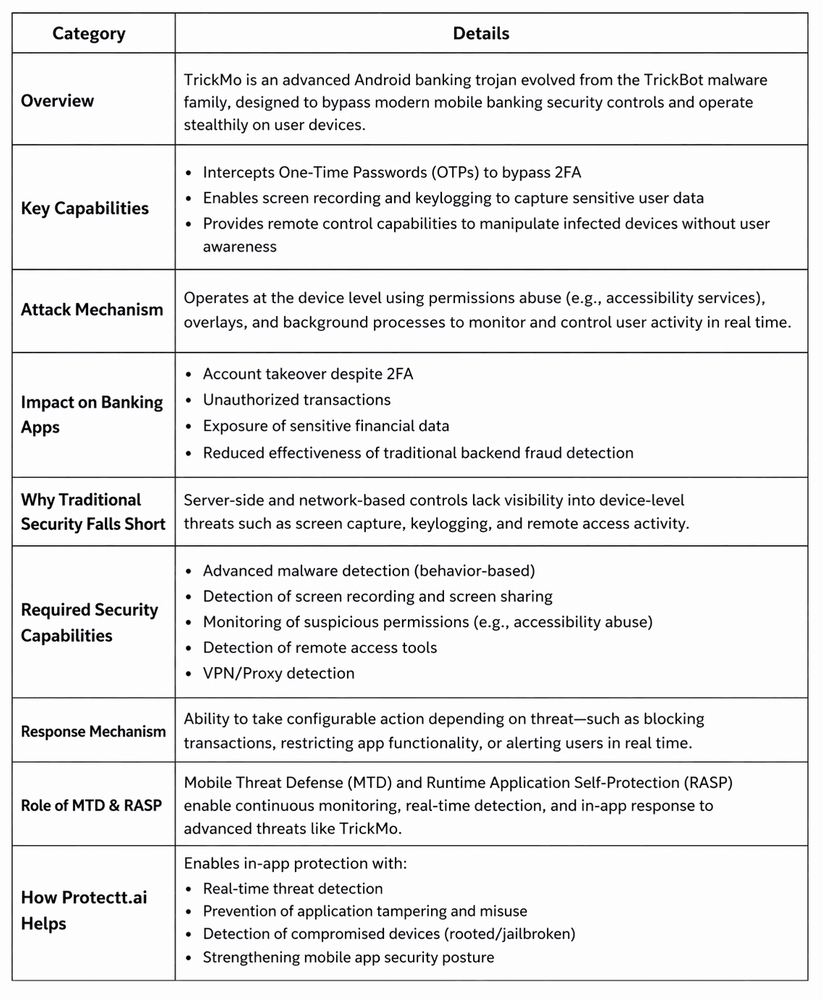
Emerging Threat Spotlight: TrickMo Malware
One of the clearest indicators of how mobile banking threats are evolving is the emergence of advanced malware like TrickMo: an Android banking trojan that has significantly expanded its capabilities beyond traditional threats.
Originally linked to the TrickBot malware family, TrickMo is designed specifically to bypass modern mobile banking defenses and operate stealthily on compromised devices.
Conclusion: Moving to Real-Time, In-App Protection
Mobile banking security in the UAE is clearly shifting toward applications that can detect and stop threats in real time. From application integrity checks and rooted/jailbroken detection to preventing application tampering, screen recording and screen sharing attacks, and identifying VPN/proxy-based access, the focus is on continuous, in-app protection.
With capabilities like Mobile Threat Defense (MTD) and Runtime Application Self-Protection (RASP), combined with advanced malware detection, and configurable action depending on threat, banks can significantly strengthen their defense against evolving threats.
Protectt.ai is well-versed in enabling these capabilities for leading banking apps.
Schedule a demo to see how you can strengthen your corporate mobile app’s security posture.